
The celluveyor of cellumation FAQ
We are cellumation and our product is called celluveyor. The word comes from the English term: conveyor and the lowest common denominator of our technology: the cell. In this FAQ we answer questions that are frequently asked. Your question is not (yet) included? No problem – this is the most important link to our team.
Functions and technical data
Which conveying functions can the celluveyor perform?
The celluveyor is a software-driven conveyor system. The hardware is always the same; the function is determined by the software. As a result, the celluveyor is multifunctional and can handle (almost) any function in your material handling system.
At the moment, the celluveyor…
-
- BULKSORT can organize and sort chaotically fed packages: powerful and compact in less than 8m2.
- DEPAL can be responsible for layer singulation and sortation in automated depalletizing systems.
- can easily center and align objects.
- can of course also transport goods straight ahead – but that would bore our system a bit.
What is the weight of a celluveyor system?
The 150 cell weighs approximately 2.1kg, while the 200 cell weighs approximately 2.8kg. These values, depending on the installed or required cell size, provide a good orientation for estimating total weight. Frame and cabling must be added, obviously. If you request special celluveyor products from us, we will gladly provide you with more detailed information.
What is the minimum height of the celluveyor?
A minimum construction height of 300mm is required for the installation of our cells. Moreover, we require an additional approximately 100mm for the cable connection.
How is the movement of an object ensured?
About our vision system: The system is the “eye of the software”, recognizes the objects and gives the right impulses for the desired movements.
How is it ensured that all packages exit correctly?
A vision system monitors what is going on on top of our celluveyor. The vision system manages the packet ballet, corrects incorrectly routed packets, serves as the software’s eye, and is critical for low error rates.
Integration & Configuration
How does the integration into my material flow and IT system work?
In most cases, the celluveyor simply integrates as a “plug’n’play” system into the higher-level material flow system. The higher-level material flow system communicates with the celluveyor via a common interface (e.g., Digital I/O or Profinet) with simple instructions, which are then independently translated into complex movements by the celluveyor. Complex programming work in the PLC of your material handling system is not necessary. Your system communicates the task, the celluveyor solves it independently and takes over the execution of the entire motion logic of the objects.

Mit dem Laden des Videos akzeptieren Sie die Datenschutzerklärung von YouTube.
Mehr erfahren
What programming language is used to program the celluveyor?
You do not need to be concerned about programming. We will gladly handle it for you: you will receive a fully programmed system that you will be able to control with simple instructions via a common interface (Digital I/O or Profinet). More information can be found on the product pages
How do I configure a celluveyor?
You don’t. The celluveyor is supplied with the necessary data via the interface, including information on the packages, and then runs on its own. The important thing to remember is that minimum sizes must be adhered to.
Maintenance & Security
What safety standards does the celluveyor meet?
The celluveyor is a tame tiger that does not need to be kept in a cage, unlike other common material handling systems. Each wheel is powered by a small motor that can be stopped individually with a finger. Naturally, the celluveyor complies with all applicable EU standards and directives. At the same time, it has an IP 54 protection rating, so dust and dirt aren’t a problem for our Tiger.
What is the celluveyor's IP classification?
Our cells are IP 54.
What happens if a cell is defective?
Essentially, our cells are built to be extremely durable. However, if a cell fails, the neighboring cells will report it as defective, and you will receive an error message. Your technicians can replace a cell with a screwdriver in less than 5 minutes. At the same time, the celluveyor provides six-fold redundancy, which means that the surrounding cells take over and, with the help of the vision system, realign the passengers.
How does the replacement of a cell work? Do I need specialized personnel for this?
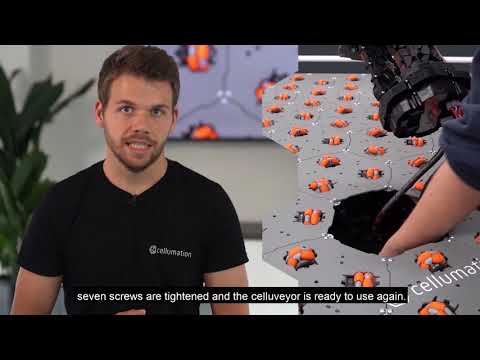
Three words: quick and easy! And no, you don’t need specialized personnel to do it. The celluveyor has to be stopped and switched off – 7 screws are loosened – the cables are plugged out of the defective cell and plugged into the spare part cell – 7 screws are tightened – the celluveyor is switched on – the spare part cell automatically detects its position and the system is 100% operational again within minutes.
Mit dem Laden des Videos akzeptieren Sie die Datenschutzerklärung von YouTube.
Mehr erfahren
Is the maintenance of the celluveyor cells complex?
No, the ball bearings do not require maintenance, and the motors are brushless. Wear parts like belts or wheels for example, can be easily and quickly replaced without the use of any tools.
Objects & Materials
Which objects can be conveyed with the celluveyor?
We love it flat. We love it bigger than 150 mm x 150 mm! Cartons – great! Boxes – great! Plastic totes (KLTs) – great! Other objects with flat bottom – great!
Do you find your object correctly described with these attributes? Then everything speaks in favor of using the celluveyor! Which objects exactly can be transported? The list grows every day: boxes, crates, small load carriers, tool carriers, tires, steel… Feel free to contact us if your object is not listed – we are very interested in testing your object and extending the list!
My objects do not have a flat bottom surface - can I still move them with the celluveyor?
We need as flat a bottom as possible: the difficulty increases when transporting limp bags or luggage. Simply send us a picture and a description, and we will respond quickly!
My items are quite heavy; will the celluveyor be able to handle them?
Yes, indeed! The celluveyor has a load capacity of up to 400kg/m² – 150 cell and 200kg/m² – 200 cell. As a result, the weight of your objects does not worry us.
Can the celluveyor transport pallets?
If the pallet has a plate as a base, as is often the case in the United States, we can move it without difficulty. Unfortunately, without a base, this is currently not possible.
Distribution and Delivery
Where can I buy the celluveyor for my conveyor system?
The celluveyor is part of a material handling system and must be integrated into it – therefore you can buy the celluveyor from the system integrator of your choice. Feel free to put us in touch with each other!
You don’t have a system integrator yet?
No problem, we work with many great partners. Simply get in touch.
You are a system integrator?
Then you can buy the celluveyor exclusively from us! We would be happy to discuss different possibilities for your customers.
Can I buy individual cells and program them myself?
No, it is not possible to program the cells yourself. Cell and software functionality are like Ying & Yang, like Bremen & the Town Musicians and like cellumation & the Hexagon – simply inseparable! That’s why we always deliver the cells as a complete package, including software.
How much does a m² celluveyor cost?
The cost of a celluveyor is always a combination of hardware and software and is determined by the system’s size, the complexity of the task to be performed, and the type of objects to be transported. Please describe your application so that we can provide you with information on the appropriate product.
What information do you require in order to send me an offer?
You describe us your application and we advise you how we can solve it with one of our products.
Cooperation with system integrators and end users
I am an end user interested in purchasing a celluveyor. Who can I get in touch with?
The celluveyor is part of a material handling system and must be integrated into it – therefore you can buy the celluveyor from the system integrator of your choice. Feel free to put us in contact with each other!
I am a system integrator and would like to learn more about the celluveyor. I may also have some interesting applications in mind. What is the best way to get in contact?
You are welcome to get in touch with us directly. We will then work together to find the best solution for your customers. We will gladly assist you over the phone at +49 421 331135 0 or via email at info@cellumation.com.
Nico Loibersbeck
Sales

We love our technology and love to talk about it. There are still questions open?